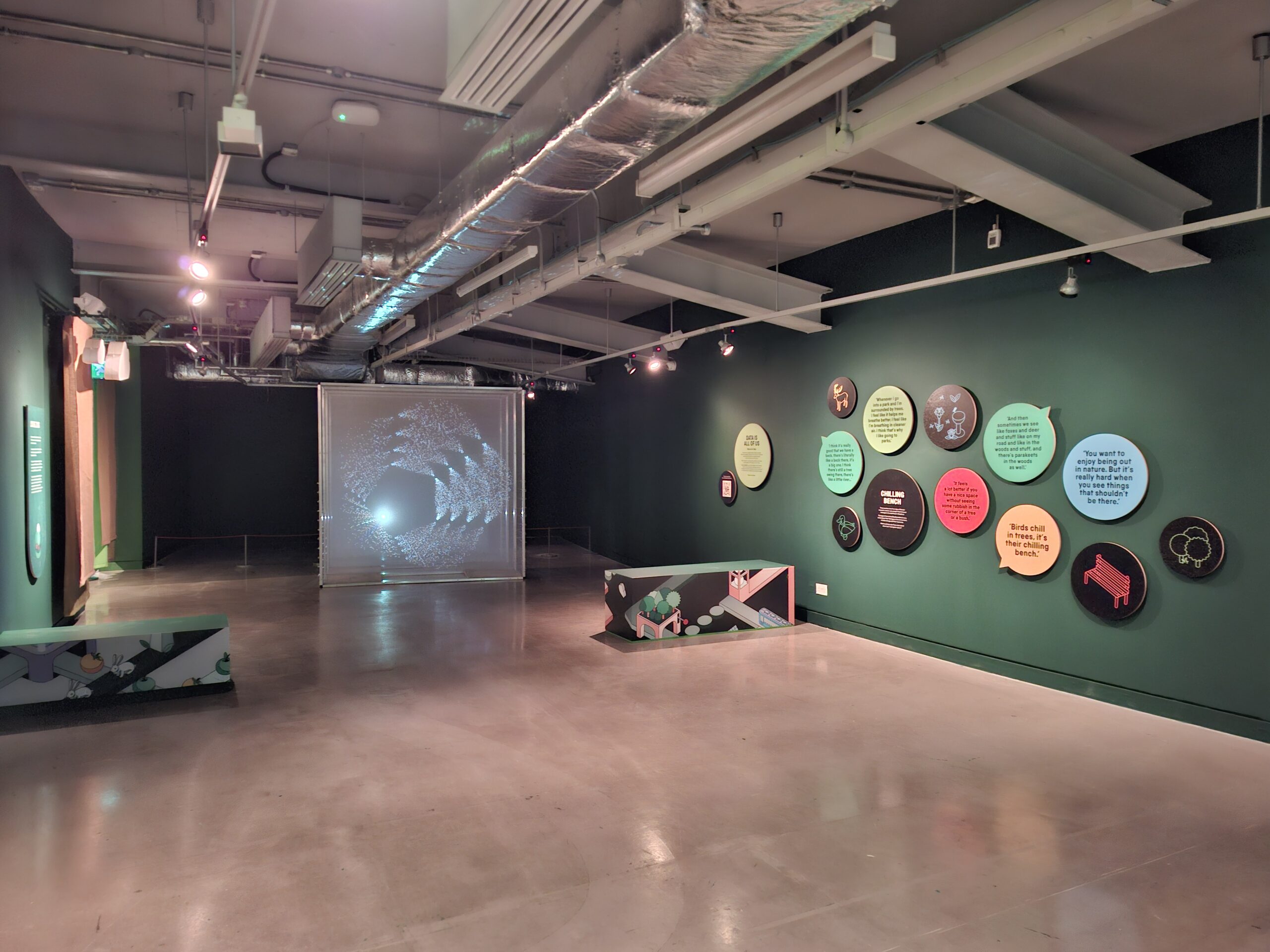
Science Director Roger Highfield describes an interactive art installation that reveals the extraordinary power of the Born in Bradford health study.
A scientific study of thousands of Bradfordians may seem an unlikely seed for an art installation. Yet the data collected from them has now been transformed into a living, immersive sculpture at the National Science and Media Museum—a glowing constellation of light that invites visitors to reflect on their community’s collective health.
The experience, Living Dots: Nature, People and Place, draws on Born in Bradford (BiB), one of Britain’s most ambitious long-term health studies, which since 2007 has followed more than twelve and a half thousand families, studying mothers when they were pregnant who went on to have more than thirteen and a half thousand children.
Recruitment to the study takes place not through flyers or social media but midwives, health visitors and schools. BiB’s clinics are located inside shopping centres. The programme’s newsletters—translated into Urdu, Punjabi and Polish—are read by thousands.
Monitoring everything from maternal health and air pollution to school attainment, the UK’s youngest city has evolved to be one of Europe’s most closely observed urban laboratories, or what BiB’s director, Professor Rosie McEachan calls a “city collaboratory”, a nod to how the city and the NHS are joined at the hip by this effort.
“We try to do what is important for stakeholders in the city, whether it’s people working in education or the health system or the local authority,” she says. “But we also tried to make it fun for families as well, whether through sending birthday cards or organising events, and try to find creative ways to disseminate our findings.”
Since the very beginning, the project has worked with the National Science and Media Museum: “We’ve held count countless scientific conferences and festivals there, and teddy bears’ picnics in galleries.” Now, when it comes to Living Dots, it “brings the beauty of the data and science to life in a way that’s really difficult to do – it is magical.”
Data as Civic Self-Reflection
Celebrated by an exhibition created by the team at the National Science and Media Museum, the data visualisation studio Tekja was commissioned by the Bradford Science Festival to create an artistic centrepiece, a glowing, layered mesh where each dot represents a person who takes part in Born in Bradford.
Visitors see their own contributions appear alongside thousands of earlier responses. Shadows cast by museumgoers become part of the sculpture, a reminder that the data are constantly evolving.
“We have gathered definitive evidence on the impacts of pollution on pregnant women, low birth weight, children’s DNA, children’s brain development, and exposures in everyday life and how they impact on children’s health and well-being,” says Prof McEachan. “One of the strongest impacts from our study is looking at the environment as a whole, the structures in which we live, and their impact on our health and well-being.”
Born in Bradford’s latest findings show that one in three Bradford children do not play outdoors after school, and one in five stays inside at weekends. Some young people have surprisingly low levels of Vitamin D as a result.
The pattern varies by ethnicity: British-heritage children are more likely to play outdoors on school days, while South Asian-heritage children spend more time outside at weekends.
“A lot of the research we’ve done in Bradford has shown how important these high quality green spaces, parks and gardens are for health and well-being, and the council have used that and being able to bring investment in,” says Prof McEachan “Now you’ve got beautiful gardens in the city centre where you once had four lane highways.”
Unequal Status, Unequal Health
The Born in Bradford study links with pioneering studies by Sir Michael Marmot at University College London by providing empirical evidence of how inequality in the community translates into health inequalities. “If you travel 10 miles between Manningham and Ilkley, you’ll find that there’s a ten-year difference in life expectancy,” she says.
BiB has helped local schools reduce childhood obesity, informed clean-air policies, and shaped new clinical pathways for pregnant women, along with influencing schools’ admission policies. It has even supported urban planning, from speed-restriction zones to school-street redesigns.
“Now the oldest young people in BiB are turning 18,” adds Prof McEachan. “Our focus will change as children grow up and we do a lot of work trying to prioritise research questions with the young people themselves: we’ve done a lot of work recently on mental health, skills and aspiration – how do young people become economically independent and productive and fulfil their potential?”
They can even start to track health effects that straddle generations, now that the first babies have been born among the BiB cohort. “That’s the real power of a longitudinal study – you can look at these intergenerational effects: the health of all of us is influenced by the health of our grandmothers.”
Bradford as a Bellwether
With backing from national funders such as the National Institute for Health and Care Research, Wellcome, the Medical Research Council, and the Economic and Social Research Council, the implications of Born in Bradford extend beyond West Yorkshire.
Cities across Britain are struggling with similar questions: how to preserve green spaces, how to make streets safe for children, and how to ensure that nature is accessible to families squeezed by the cost-of-living. Bradford’s unusually young population—almost a quarter under 16—makes it a useful preview of national trends.
Christopher Whitby, who leads public programming at the museum, sees the exhibition as part of a broader effort to recast Bradford’s narrative during UK City of Culture in 2025: “Living Dots is a way of letting people look that future in the eye.”
Roger Highfield is a guest author
Roger Highfield is Science Director at the Science Museum Group.
