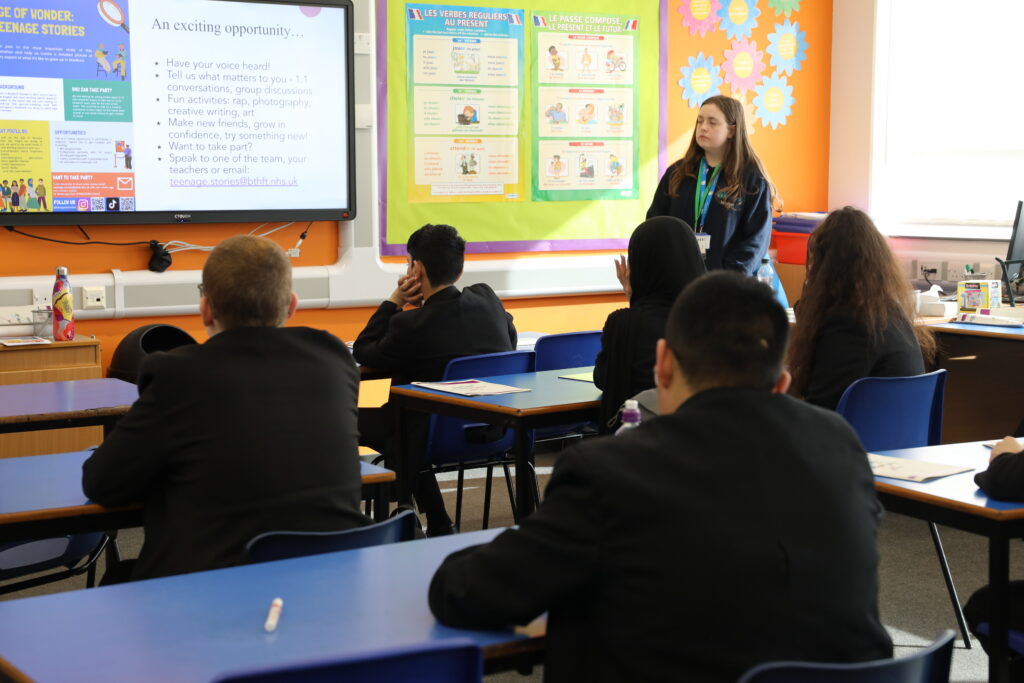
Schools are well placed to support wellbeing and mental health of young people, as they are spending much of their time there. The question is: how can we encourage a positive school environment to support student wellbeing?
This is the question behind the Promoting Positive Adolescent Mental Health (PPAMH!) research project, a school-based intervention that aims to make a positive mental health is built into everyday life, not bolted on as an afterthought.
The study is adapted from an intervention previously trialled in India and Australia that reduced bullying, depression and risk behaviours among students.
It is guided by the World Health Organisation (WHO) health-promoting school initiatives and funded by the National Institute for Health Research.
How does the intervention work?
PPAMH! works at three levels within a school:
- whole-school activities that include things such as a speak out box and wall magazine;
- peer group activities covered via interactive workshops for up to 8 students on a specific topic;
- individual activities like one-to-one sessions with students.
During the intervention we ask students what topics are important to them and which they would like to explore to support their wellbeing. These topics could be anything from around mental health, physical health and social media to sleep, exam pressure, bullying and relationships.
During one-to-one sessions, the students meet with the wellbeing mentor to have an informal chat and find out about any services that may be available to support them. Then they have a second meeting to discuss and complete a referral to the appropriate service and the final meetings are to follow-up on how they are getting on with the service.
Via this intervention we want to give students tools to support their wellbeing and hopefully provide them with a toolkit to navigate their mental health now and in their future.
What did we find out so far?
The students are working closely with the PPAMH wellbeing mentors, Isna and Neelam. Their work with students helped research team to identify that students reported “a lack of understanding from teachers to students, resulting in feelings of isolation for some students when ‘opening up’ to their teachers.”
Thus, our wellbeing mentors focused on closing that gap in two ways:
- Firstly, they tried to validate themselves as a unique support system and a distinct kind of support in school, outside of teacher or exclusively mental health authority figures,
- They also worked to improve communications between teachers and students via the School Health Promotion Committee.
Isna and Neelam have shared:
“Across the last term this approach has successfully allowed us to build connection with our students as well as staff, whilst also supporting the students in the navigation of various issues they are facing at this stage in adolescence.
This level of rapport and connection was made tangible when the students chose to invite us to their end of year performance and asking to continue working with us the next academic year.”
Students have invited wellbeing mentors to their school play and reflect that they are really enjoying the sessions.
“At the beginning I would of not go involved/spoken, but now I am really enjoying these wellbeing sessions”, – shared one of the students with Isna and Naleem.
“I just wanted to take this opportunity to thank you for all you have done so far with PPAMH and the impact it’s starting to have with our students.” – shared a teacher from a school participating in the intervention.
What is next?
We want to know how we can adapt this intervention to work best for our schools in the UK.
We will interview school staff members who are involved in providing the intervention in the schools and the well-being mentors. This will tell us about what has worked well and the barriers to the intervention, how these could be overcome and changes that schools make to the intervention.
About the study: https://borninbradford.nhs.uk/what-we-do/studies/promoting-positive-adolescent-mental-health/
